Lesson 2 of 6
Put the sky
on a circle.
We have identified when and where Mira was born. Before we find the planets for that moment, we need a way to describe their directions on the page. A position such as “17° Taurus” will give us an address around a circle.
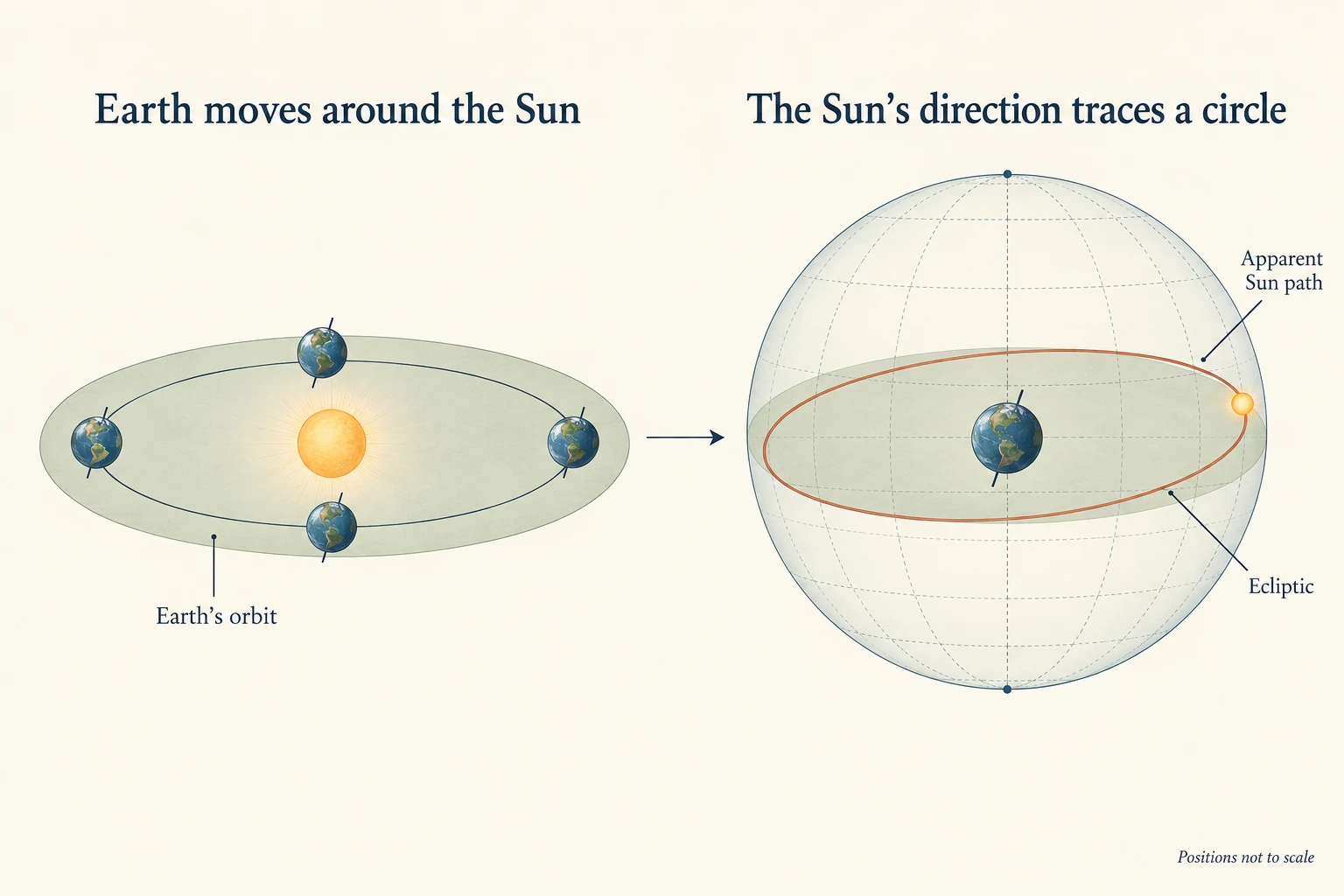
Imagine returning to the sky above Mira’s birthplace throughout a year and marking the Sun’s direction against the distant stars. As Earth travels around the Sun, those directions trace a path around the sky. We call this path the ecliptic, and we’ll use its circle as the reference for placing the planets on Mira’s zodiac wheel.
To describe a planet’s position on the wheel, we measure how far around this circle its direction lies. That angle is its ecliptic longitude. A planet can also lie north or south of the ecliptic, so longitude gives us only the part of its direction that runs around the circle; it does not describe that north–south displacement or the planet’s distance from Earth. The United States Naval Observatory glossary defines these coordinates.
A circle needs a starting point.
If we walk around a circular track, a distance such as “a quarter of a lap” tells someone where we are only when they know where the lap began. Mira’s zodiac circle needs an agreed starting line for the same reason: an angle such as 47° must be measured from a particular direction.
We can find one useful starting direction by extending Earth’s equator outward onto the sky. This imaginary circle is the celestial equator. At the March equinox, the Sun crosses it heading north along the ecliptic, and the tropical zodiac takes that crossing direction as 0° Aries. Its starting line is therefore tied to the equinox rather than to a particular star.
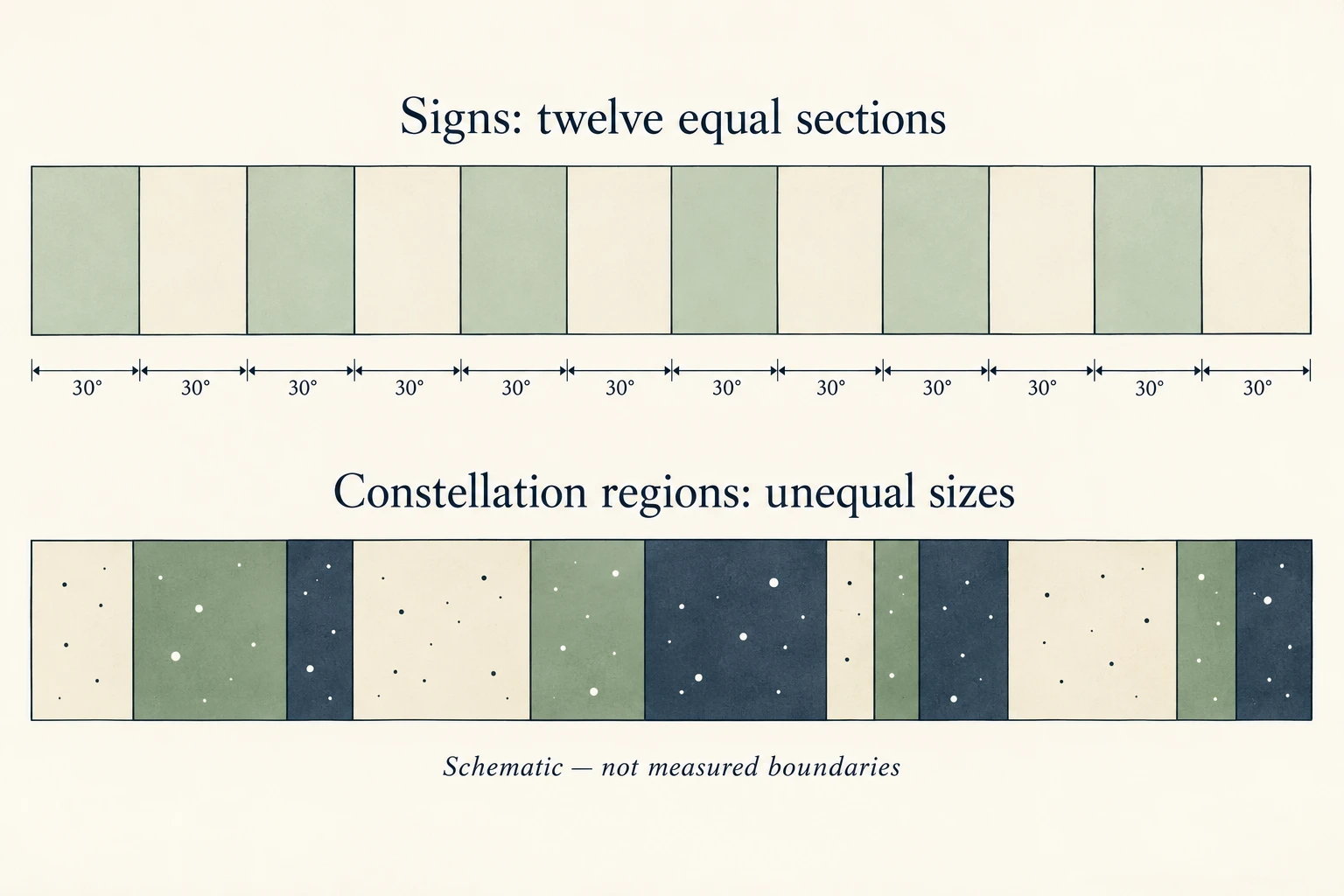
With a starting line established, we can divide the circle into the familiar zodiac signs. A full turn is 360°, so dividing it into twelve equal sections makes each section 30° wide. Beginning at 0° Aries, we give those sections their sign names in order.
360° ÷ 12 = 30° per sign
The first section, Aries, begins at 0°. After its 30° we reach Taurus, and another 30° brings us to Gemini at 60°. Continuing to add 30° takes us through all twelve signs and back to the starting direction.
A sign and a constellation are different things.
The sign names may bring pictures of star patterns to mind, but we need to keep two kinds of division distinct as we build Mira’s wheel. A tropical sign is one of the twelve equal 30° sections we have just marked out. A constellation is a region of the starry sky, and those regions have unequal sizes. When we read “Taurus” on this wheel, we are naming an angular section; that name does not establish that the planet lies within the constellation Taurus.
Behind the starting line: Hipparchus and a slowly changing sky
More than two thousand years ago, Hipparchus compared star positions with observations made before his time and found that their positions relative to the equinox had shifted. A reference that seemed fixed was slowly changing against the stars.
We call this change precession: Earth’s axis gradually changes direction, shifting the equinox along the ecliptic. As a result, a zodiac anchored to the equinox and one anchored to the stars do not remain aligned over the centuries. This helps explain why we need a date-dependent offset when we change the reference for Mira’s chart.
Now take the stars as your reference.
To build the star-referenced chart we’ll use for Mira, picture a second ruler laid around the same circle. It has the same twelve equal sections as our tropical ruler, but its starting point uses a reference tied to the stars. A planet keeps the same direction while we change the starting line from which we read its position.
We call this second ruler a sidereal zodiac. There are different conventions for setting its reference, and for Mira’s chart we’ll use Fagan–Bradley. Keeping that choice explicit matters because it affects the positions we will read. Its signs still span 30° each, rather than following the unequal boundaries of the constellations.
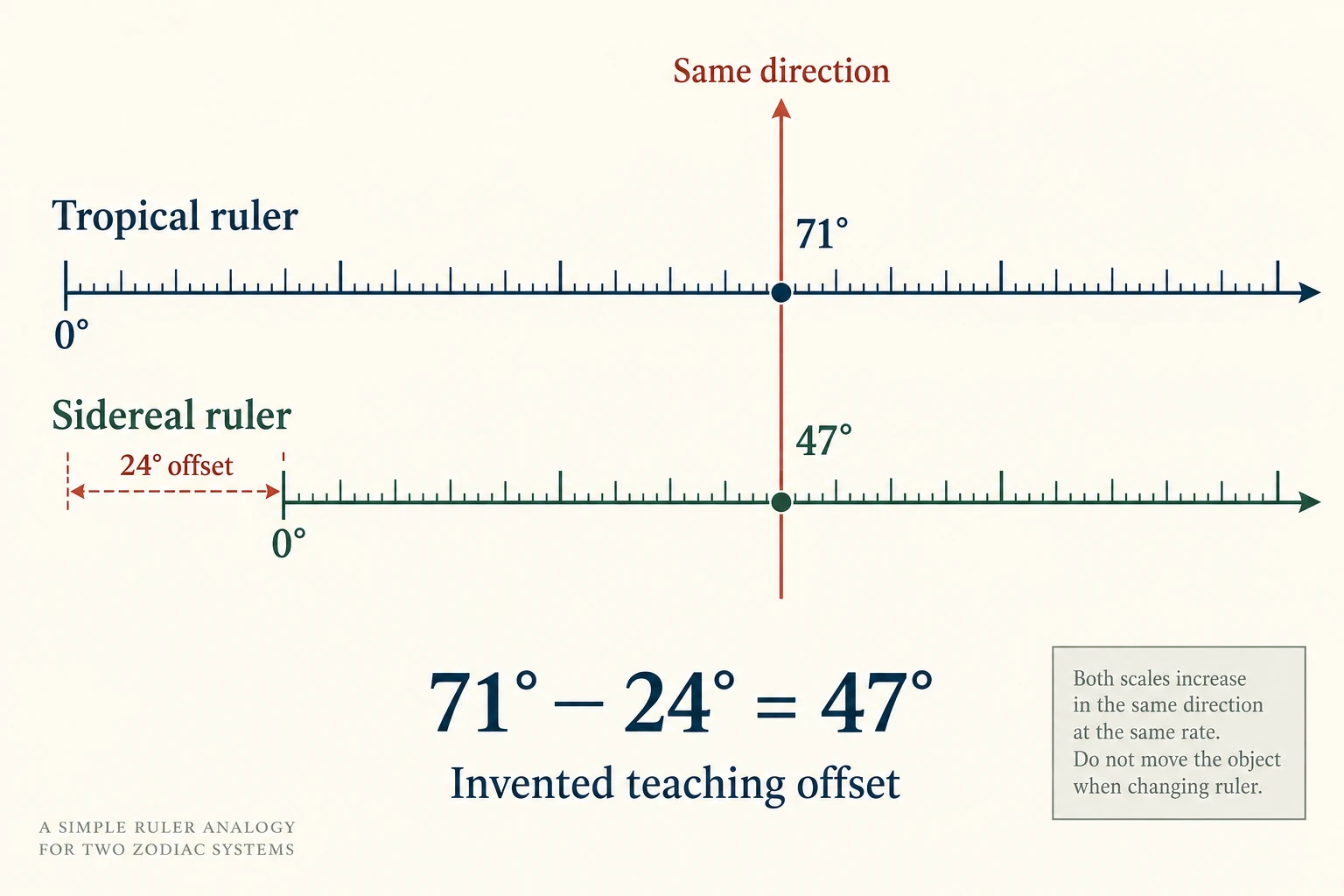
To move a reading from the tropical ruler to the sidereal one, we need the angle between their starting points. This offset is called the ayanamsa. It changes with the date and with the chosen sidereal reference, so Mira’s chart will need the Fagan–Bradley value for her birth moment. We subtract the offset from the tropical longitude, then bring the answer back within one turn of the circle if necessary. The Swiss Ephemeris reference explains the relationship and the different conventions.
71° − 24° = 47°
For practice, suppose the offset is exactly 24°. A tropical reading of 71° becomes a sidereal reading of 47°. Here 24° is only a teaching value; a real Fagan–Bradley chart needs the offset calculated for its birth date.
On the tropical ruler, 71° is 11° into Gemini, whose section begins at 60°. After subtracting our invented offset, the sidereal ruler gives 47°, which is 17° into Taurus. These readings describe the same direction using different starting lines; the subtraction changes the address we give it.
Give the wheel a familiar orientation.
As you explore the teaching wheel below, look for 0° Aries on the left. The signs proceed counterclockwise, starting downward through Aries toward Taurus. This gives us a consistent way to practise reading an angle. A finished natal wheel conventionally puts the rising point, called the Ascendant, on the left; when we find that point for Mira in a later lesson, we’ll rotate the zodiac to meet it, so Aries will not necessarily remain there.
For now, explore longitudes measured from the sidereal starting point. The arithmetic within each sign works just as it did on the tropical ruler.
Try a direction
One angle.
Two ways to read it.
Move the marker around the circle. Watch the sign change each time you cross another 30°.
The Taurus section starts at 30°. 47 − 30 = 17° into the sign.
Read the address: 47°.
When we calculate Mira’s chart in the next lesson, we will receive a longitude for each planet. Before using those results, let’s practise with 47° of sidereal longitude. This is a teaching value, independent of Mira’s calculated sky, and it lets us work through how an angle becomes a sign and a degree within it.
Starting at 0°, the first 30° take us through Aries and bring us to the beginning of Taurus. Our 47° direction lies beyond that boundary, so we subtract Taurus’s starting angle, 30°, to find how far into the sign it falls. The remaining 17° give us the address 17° Taurus.
47° − 30° = 17° Taurus
Subtract the starting longitude of the sign to find how far into it you are.
At a sign boundary, we begin counting within the new sign: exactly 30° is therefore 0° Taurus, rather than 30° Aries. The same rule applies when we complete the whole circle. Exactly 360° brings us back to 0° Aries.
See all twelve signs and their starting angles
| Sign | Starts at | Continues up to |
|---|---|---|
| Aries | 0° | 30° (next sign) |
| Taurus | 30° | 60° (next sign) |
| Gemini | 60° | 90° (next sign) |
| Cancer | 90° | 120° (next sign) |
| Leo | 120° | 150° (next sign) |
| Virgo | 150° | 180° (next sign) |
| Libra | 180° | 210° (next sign) |
| Scorpio | 210° | 240° (next sign) |
| Sagittarius | 240° | 270° (next sign) |
| Capricorn | 270° | 300° (next sign) |
| Aquarius | 300° | 330° (next sign) |
| Pisces | 330° | 360° (next sign) |
Keep the direction. Lose the extra turn.
Our subtraction can produce a negative angle, and other calculations can produce an angle larger than 360°. To put either result on the wheel, we keep its direction while removing or adding whole turns. For example, 407° takes us once around the circle and then another 47°, so subtracting 360° leaves the same direction.
407° − 360° = 47°
407° and 47° point to the same place on the circle.
Bringing an angle into the range of one turn is called wrapping an angle. For a negative result, we add a turn instead: −30° means moving 30° backwards from the starting line, and adding 360° gives 330°, the beginning of Pisces. Both numbers point to the same place.
The library returns planetary longitudes from 0° up to, but not including, 360°. For our sidereal chart, we’ll first apply the chosen ayanamsa for the birth date and wrap the result. Then we can give it a sign name and a degree within that sign. Those are two ways of expressing the same direction.
For curious programmers: turn longitude into a sign
This small example is the display arithmetic. For our chart, use the sidereal longitude after conversion; this step makes it readable on the chart. It assumes a finite angle in degrees.
const wrapAngle = (degrees: number): number =>
  ((degrees % 360) + 360) % 360;

const longitude = wrapAngle(407); // 47°
const signIndex = Math.floor(longitude / 30); // 1: Taurus (Aries is 0)
const degreeInSign = longitude - signIndex * 30; // 17°
JavaScript’s remainder operator can produce a negative result. Adding 360 and taking the remainder again wraps negative angles too.
Make it yours
Try the idea.
A few questions to put the pieces together. Take your time; you can try again.
You can read a position now.
Mira’s birth record gives us a moment and a place, and we now have a way to describe directions around her chart. Once the zodiac reference is clear, we can move between a longitude and its sign address. Reading “17° Taurus,” for example, tells us to begin at Taurus’s 30° boundary and continue another 17°: 30° + 17° = 47°.
Next comes the question that makes the chart possible: how do we find the planets’ actual positions at that moment?