Lesson 4 of 6
Find the Ascendant.
We have placed the planets around Mira’s zodiac circle. To turn that circle into a view from her birthplace, we now need to find where its path meets the eastern horizon in London at her birth moment.
In the previous lesson, we measured the planets’ directions from Earth’s centre. Those longitudes tell us where to put them on the zodiac, but they do not yet tell us which directions were above Mira’s horizon. For that, we return to London at 12:00 UTC on 1 January 2000 and relate the shared sky to the place where she was born.
Imagine looking east from that place. The path we use for zodiac longitudes, the ecliptic, crosses the horizon somewhere on that side of the sky. The zodiac longitude of this eastern intersection is the Ascendant, also called the rising point. It gives us a direction with which to orient the chart; we can calculate it even if clouds hide the sky or no bright object marks the crossing.
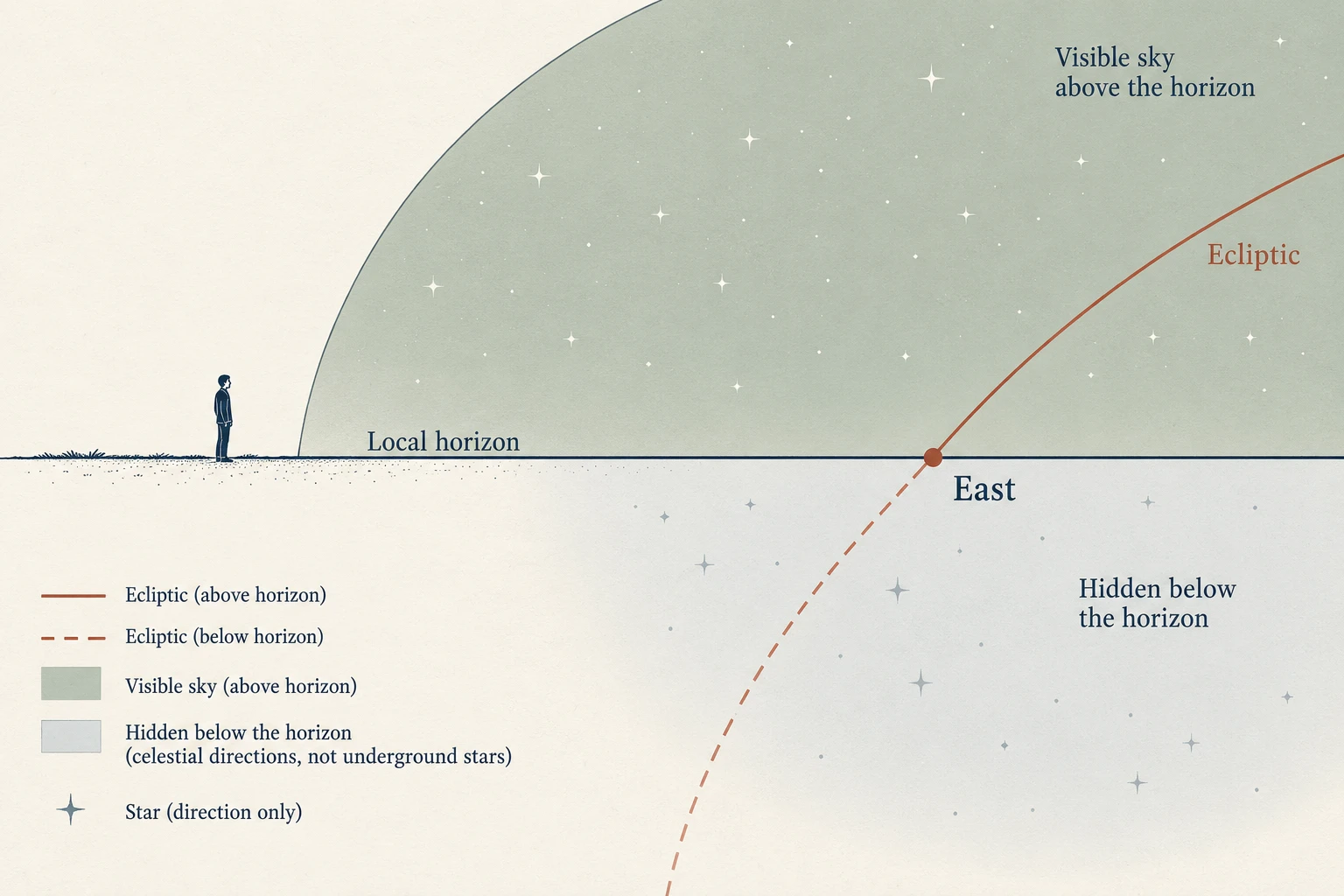
Let Earth do the turning.
If we could watch the stars for a few minutes, they would appear to move together across the local sky. Much of that apparent motion comes from Earth rotating beneath them. Mira’s horizon turns with Earth, so the part of the ecliptic meeting it changes as time passes. This is why an accurate birth time matters for the Ascendant even when the planets remain in the same zodiac signs.
Location matters too. Longitude places London around the turning Earth, while latitude determines how its horizon is tilted relative to Earth’s axis. Another observer, elsewhere at the same moment, can have a different eastern intersection. We therefore need both the birth moment and the birthplace to orient Mira’s chart.
A local sky engraved in brass
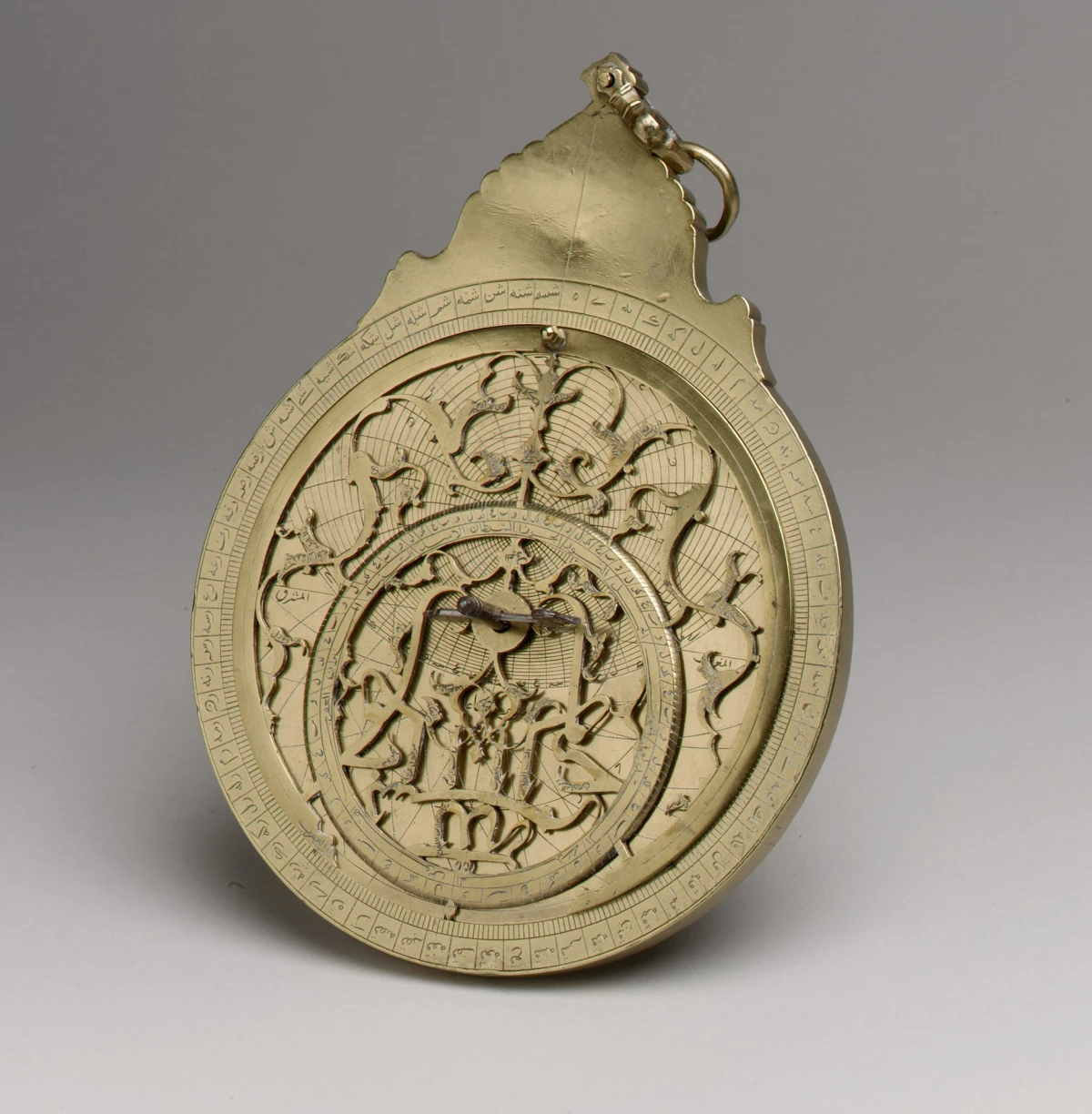

A fourteenth-century brass astrolabe in Oxford’s History of Science Museum makes this dependence on place tangible. Its engraved sky projection uses a latitude of 51°, intended for Oxford. The maker built a choice of geographical location into the instrument itself, so its representation of the sky was suited to that latitude.
We make the corresponding geographical choice with Mira’s latitude in the birth form. The sky is shared, but the horizon we lay across it belongs to a place.
The Oxford astrolabe, about 1350 · History of Science Museum
A clock for the turning sky.
To work out how Mira’s horizon is oriented, we first need to know how far Earth has turned relative to a reference direction in the sky. The measure used for this is sidereal time. Here, “sidereal” refers to measuring Earth’s rotation against a celestial reference; it is a different use of the word from choosing a sidereal zodiac. A tropical chart also needs this rotation calculation.
We begin with the orientation at Greenwich and adjust it for the birthplace’s longitude. A place east of Greenwich is farther around Earth in the positive direction, so we add its longitude; a place west has a negative longitude, which reduces the angle. If the result falls outside the circle, we wrap it around 360°, just as we did with zodiac longitudes.
100° + 20° east = 120°
Suppose Greenwich’s reference angle is 100°. Adding 20° for a place east of Greenwich gives 120°; adding −20° for a place west gives 80°. These invented numbers let us practise the longitude adjustment. They describe a local rotation angle, rather than a calculated Ascendant for Mira.
Intersect two circles.
The local rotation angle tells us how far around Earth we are looking, but the horizon’s tilt also matters. We now bring in Mira’s latitude and the tilt between the ecliptic and Earth’s equator. Together, these angles describe how the two circles meet. The calculation uses trigonometry to locate their eastern intersection and expresses the answer as a zodiac longitude.
The same circles cross on the western side too. This opposite point is the Descendant, 180° of zodiac longitude from the Ascendant. We can therefore find it by adding half a circle and wrapping the result if necessary.
To find the other pair of chart angles, imagine a circle passing through the north and south directions and the point directly overhead. This is the local meridian. Where the ecliptic crosses its upper half, we find the Midheaven, often abbreviated MC; the opposite point is the Imum Coeli, or IC. Unlike the opposite pairs, the MC and Ascendant are not necessarily separated by 90° of zodiac longitude.
These calculations establish directions in Mira’s local sky. Our Fagan–Bradley conversion then expresses them in the sidereal zodiac we chose earlier. As with the planets, the conversion changes the longitude labels while leaving the physical directions in place.
47° + 180° = 227°
Using our practice Ascendant of 47°, or 17° Taurus, adding 180° gives 227°, or 17° Scorpio. This is the Descendant: the two directions face each other across the chart. These practice angles illustrate the arithmetic rather than reporting Mira’s calculated angles.
Watch a birth time change the angles.
We can now see the effect of Earth’s rotation in the calculator. Calculate the angles for Mira or the record you entered and note the Ascendant, then open “Change birth details” and move the birth time forward by ten minutes. Save and calculate again to compare the two results. Afterwards, restore the original time; if you are following Mira, you can use her example to restore the record.
As you compare the results, notice that the Ascendant does not move at a steady rate of one sign every two hours. Latitude and the ecliptic’s tilt make some parts of the zodiac rise faster than others. The calculation lets us measure what a ten-minute change does for this birth, without assuming that it would produce the same change everywhere.
Your sky, calculated
2000-01-01 at 12:00 UTC · 51.5° latitude, -0.12° longitude
Change birth details
Your turn
Choose your moment.
Use your own birth details, or follow Mira. Enter the date and time in UTC, including any change of date when converting from local time.
2000-01-01 at 12:00 UTC · 51.5° latitude, -0.12° longitude
Saved birth details stay in this browser when you reload or return. Use Mira’s example to clear your saved record. No birth details are sent anywhere. Planet calculations arrive in a later lesson.
Each calculation loads only the sky data needed for your birth year, usually less than 100 KB, alongside the calculator. Saved birth details stay in this browser for your next visit.
Make it yours
Try the idea.
A few questions to put the pieces together. Take your time; you can try again.
Turn the chart to face the horizon.
We now have a way to orient Mira’s zodiac circle around her local horizon. On the completed wheel, we will place the Ascendant on the left and the Descendant on the right, rotating the zodiac into position around them. With that orientation established, we can begin dividing the chart into houses.