Lesson 5 of 6
Construct houses.
Mira’s Ascendant has given us a starting direction in her local sky. We can now use it to divide the chart into houses, following a rule whose steps we can explain.
We have already divided the zodiac into twelve equal signs and placed Mira’s planets within them. Adding houses gives the chart a second set of divisions, related to the local sky we explored in the previous lesson. Although signs and houses both number twelve, they serve different purposes: the zodiac provides our reference for celestial directions, while a house system supplies a rule for arranging boundaries around the local chart.
Before we can say which house contains a planet, we need to locate the boundary at which each house begins. This beginning is called a house cusp. Different house systems construct these cusps differently, so choosing a system is a choice of method. We’ll follow the geometry of those methods here; symbolic interpretation is outside this course.
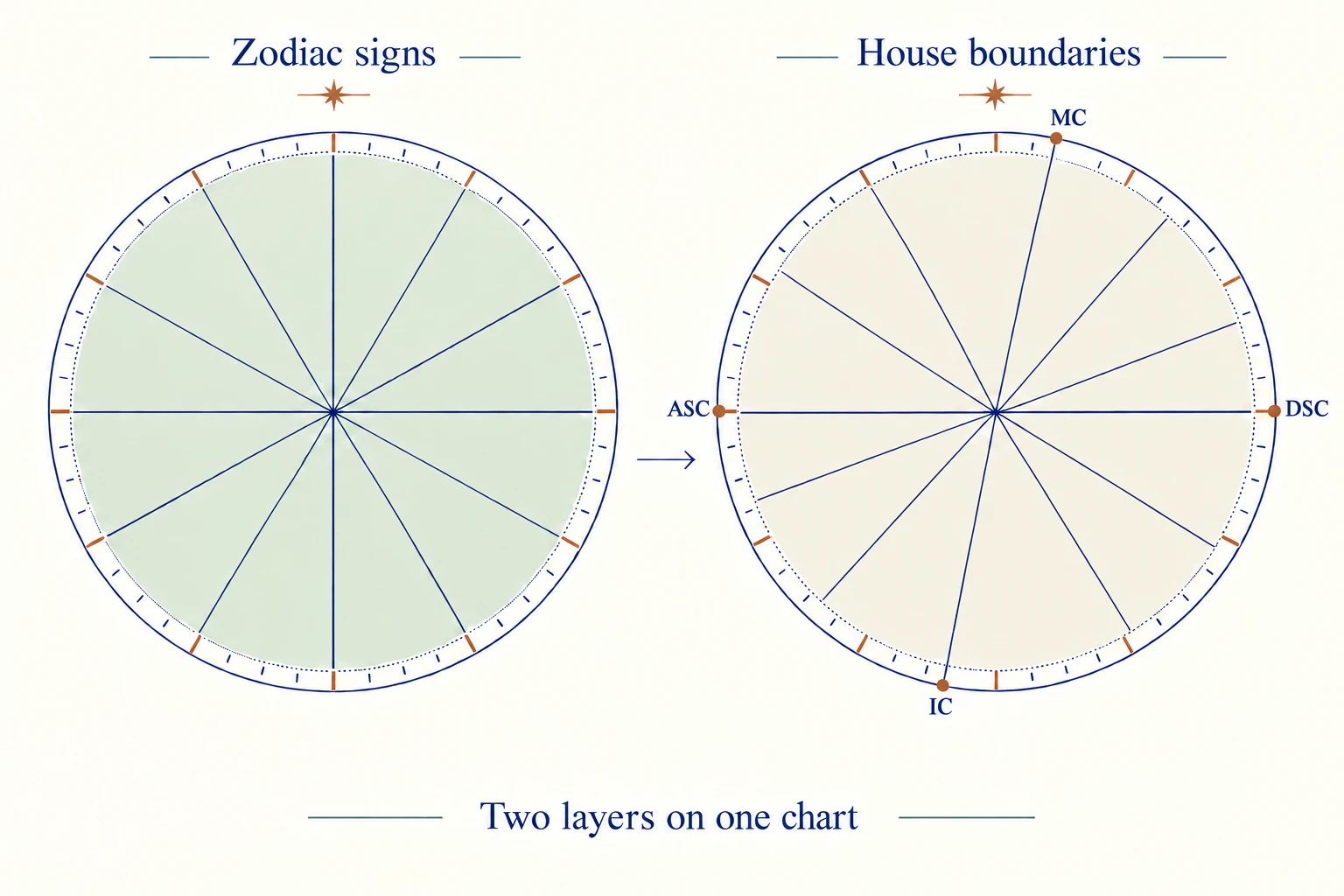
Start with Equal houses.
The simplest construction to follow begins exactly at the Ascendant and gives every house the same width. Since twelve houses must fill a 360° circle, dividing 360° by twelve gives 30° per house. This is the rule for Equal houses: the first cusp is the Ascendant, and each following cusp is found by adding another 30°. Whenever an angle reaches 360°, we wrap it back around the circle.
47°, 77°, 107°, 137° …
We’ll practise with the same invented Ascendant of 47°, or 17° Taurus, used in the previous lesson. Adding 30° gives a second cusp of 77°, or 17° Gemini; adding another 30° gives a third of 107°, or 17° Cancer. The houses have the same width as the signs, but their boundaries begin 17° into each sign. These are teaching angles, rather than Mira’s calculated house cusps.
To reach the fifth cusp, we take four 30° steps from the first: 47 + 4 × 30 = 167°, or 17° Virgo. The same pattern works for any house number n: take n − 1 steps from the first cusp, then wrap the result if needed. After twelve steps we have added a full 360° and returned to the Ascendant.
Whole Sign makes a different first cut.
Another construction begins with the sign containing the Ascendant, rather than the Ascendant’s exact degree. Keep our practice Ascendant at 17° Taurus. In Whole Sign houses, Taurus as a whole becomes the first house, so the first boundary is 0° Taurus, or 30° on the full circle. Gemini becomes the second house, Cancer the third, and each remaining sign supplies one complete house.
Changing the construction has moved the first boundary, while the Ascendant itself remains at 17° Taurus, inside the first house. The horizon has stayed in the same direction. For Mira’s sidereal Whole Sign chart, we must choose the sign containing her sidereal Ascendant. Simply shifting an already constructed tropical house grid would miss this choice of a whole sidereal sign.
Equal: 47° · Whole Sign: 30°
Now place an invented practice planet at 40°, or 10° Taurus. In Equal houses it lies before the first cusp at 47°, within the twelfth house. In Whole Sign it lies within Taurus, which is the first house. The planet has stayed in the same direction; the change in house comes from the dividing rule.
Let the four angles set the corners.
Equal and Whole Sign give us boundaries by taking equal steps around the zodiac. Other systems begin with all four angles we found in the previous lesson: the Ascendant, Imum Coeli (IC), Descendant and Midheaven (MC). They place these at the beginnings of houses 1, 4, 7 and 10. The four directions divide the zodiac into sections called quadrants, whose widths in zodiac degrees need not be equal.
One way to fill in the intermediate boundaries is to divide each quadrant into three equal arcs along the ecliptic. This is the Porphyry construction. For example, if the arc from Ascendant to IC spans 84°, dividing by three gives three houses of 28° each. A neighbouring quadrant can have a different width, so its three equal divisions can produce houses of a different size.
We can also base the divisions on the time involved in rising and setting motion, rather than on equal lengths along the zodiac. Placidus uses this kind of construction. To locate its intermediate boundaries, the calculation repeatedly refines a trial value until it reaches a solution. This method therefore differs from both adding 30° in Equal houses and dividing an ecliptic quadrant into three arcs in Porphyry.
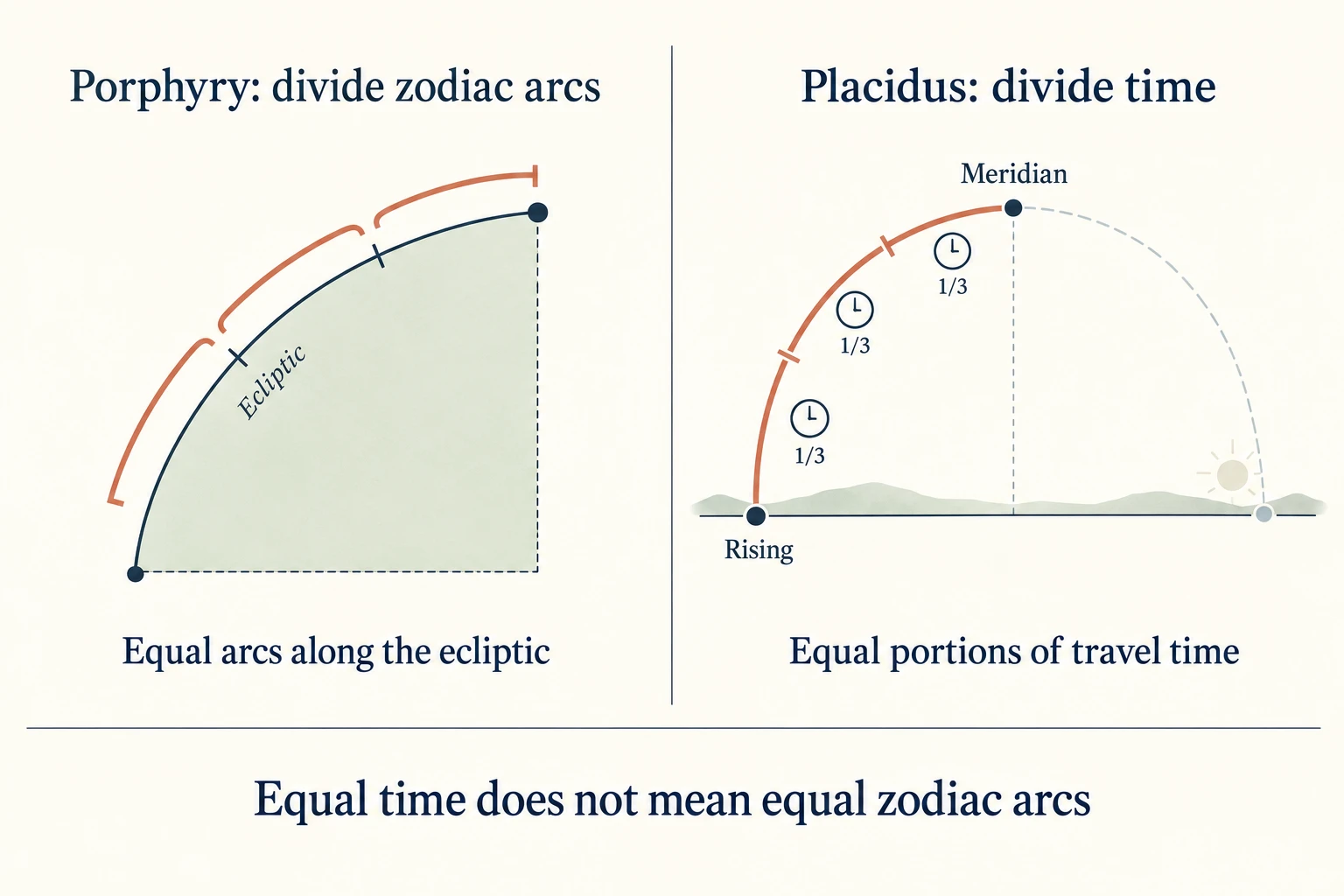
The relationship between the MC and the tenth house depends on the chosen rule. In these quadrant systems the MC sets the tenth cusp; Equal and Whole Sign do not require that alignment. Wherever the MC falls, it still marks the same calculated direction in the local sky. Astrodienst’s overview of house systems provides a comparison of the constructions.
Try a division
Same horizon.
Different houses.
This practice wheel uses an invented Ascendant and Midheaven. Switch the dividing rule; the two angles stay put.
Ascendant 17° Taurus · Midheaven 10° Aquarius
| House | Begins at |
|---|---|
| 1 | 17° Taurus |
| 2 | 17° Gemini |
| 3 | 17° Cancer |
| 4 | 17° Leo |
Placidus needs the birth time and latitude, not just these two angles. Try it with the real calculation below.
Try the rules on the same birth.
In the practice wheel above, you can compare the constructions using controlled teaching angles. The calculator below then applies the selected rule to Mira’s record, or the birth details you entered. Begin with Equal and compare the first cusp with the Ascendant. Switch to Whole Sign and calculate again: the planetary positions and Ascendant should agree, while the house boundaries can change.
Then try Placidus and read the method reported with the result. At some locations and times, the calculation cannot produce the intermediate boundaries required by that system. This engine then uses Porphyry and identifies the method actually used, so you can tell which construction produced the displayed cusps. If the polar geometry also prevents a usable Porphyry division, choose Equal or Whole Sign to continue.
This distinction also explains a difference between the two activities: the practice wheel lets you explore Porphyry directly, while the chart calculator uses it as the fallback for Placidus rather than offering it as a separate input choice.
Your sky, calculated
2000-01-01 at 12:00 UTC · 51.5° latitude, -0.12° longitude
Change birth details
Your turn
Choose your moment.
Use your own birth details, or follow Mira. Enter the date and time in UTC, including any change of date when converting from local time.
2000-01-01 at 12:00 UTC · 51.5° latitude, -0.12° longitude
Saved birth details stay in this browser when you reload or return. Use Mira’s example to clear your saved record. No birth details are sent anywhere. Planet calculations arrive in a later lesson.
Each calculation loads only the sky data needed for your birth year, usually less than 100 KB, alongside the calculator. Saved birth details stay in this browser for your next visit.
Make it yours
Try the idea.
A few questions to put the pieces together. Take your time; you can try again.
A rule you can explain.
We can now follow a house system from its starting boundary to the remaining cusps, and explain why changing that rule can place the same planet in a different house. Mira’s chart has its planetary positions, its local orientation and its house boundaries. In the final lesson, we will bring these layers together on one wheel.